
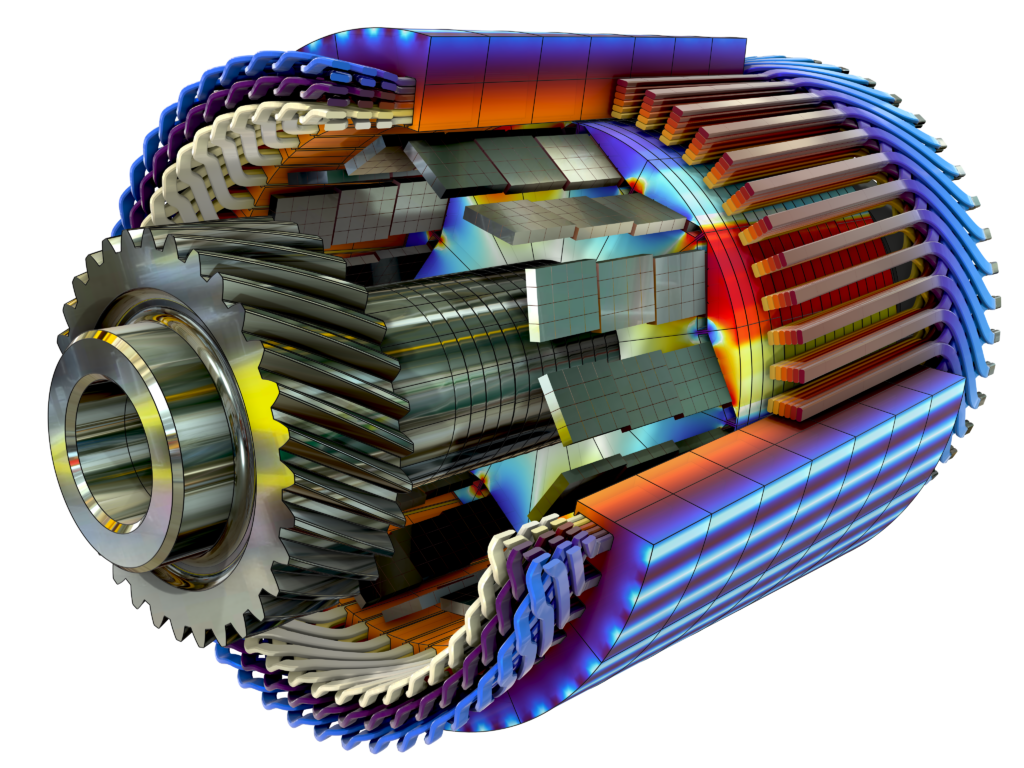


The new version of COMSOL's multiphysics software provides an environment for modeling complete systems and, with the COMSOL MCP Server, an interface for AI tools. It also includes a new Electric Motor Module as well as numerous enhancements for solvers, meshing, and simulation apps.
COMSOL, a provider of modeling and simulation software, will release COMSOL Multiphysics® Version 2027 this fall. Key new features include COMSOL Systems™, a new environment for modeling and simulating complete systems, and the COMSOL MCP Server, which enables AI agents to interact directly with COMSOL Multiphysics.
With Version 2027, COMSOL is also introducing the Electric Motor Module for simulating electric motors and generators and extending the Application Builder to macOS and Linux®. A new time-periodic solver is also designed to accelerate simulations, particularly in plasma, electromagnetics, and MEMS applications.
In addition to these major new features, COMSOL Multiphysics Version 2027 includes a new time-periodic solver that enables significantly faster simulations for applications in the fields of plasma, electromagnetics, and MEMS. Additional improvements to solvers, geometry, meshing, and features for more efficient modeling will further enhance the performance and user-friendliness of COMSOL Multiphysics.
“Technical challenges rarely occur in isolation; the behavior of each individual component influences the overall performance of the system,” says Svante Littmarck, CEO of COMSOL. “COMSOL Multiphysics Version 2027 enables users to link detailed multiphysics models with system-level simulations in an integrated environment, thereby gaining deeper insights into the interactions that determine the performance of products and processes.”
COMSOL Systems™
With COMSOL Systems, engineers can model complete technical systems at the system level and directly couple individual components with 1D, 2D, or 3D multiphysics models where a higher level of physical detail is required. With nearly 5,000 ready-to-use components, users can create electrical schematics, process flow diagrams, and user-defined, equation-based system models.
Individual building blocks can represent electrical devices, process plants, user-defined components, or complete components of multiphysics models. These components can be connected to form systems consisting of interacting components. This allows users to efficiently perform system-level modeling while incorporating detailed models wherever local physical effects must be taken into account. Overall, this process offers a modeling approach that allows users to investigate how the behavior of individual components influences the system’s overall performance.
Agent-Based Workflows for AI-Powered Simulations
While the existing AI support in COMSOL Multiphysics assists users with modeling and programming via a chatbot window, Version 2027 introduces agent-based workflows for the first time. To this end, COMSOL is introducing the COMSOL MCP Server.
The server uses the Model Context Protocol (MCP) as a standardized interface between external AI agents and COMSOL Multiphysics. Through the COMSOL API, agents can access functions throughout the modeling and simulation workflow.
An AI agent can create and/or customize a model, run simulations, review the results, and use those results to decide how to proceed. Throughout the entire process, the user can review and refine the work in the COMSOLDesktop® environment.
“This support will pave the way for more sophisticated technical workflows that integrate modeling, simulation, optimization, validation, and reporting into an iterative, goal-oriented process,” says Mikael Sterner, head of development at COMSOL. “Engineers can focus more on the questions they want to answer, while agents help carry out the simulation work.”
Electric Motor Modules
The new Electric Motor Module provides an optimized environment for modeling electric motors and generators in COMSOL Multiphysics. The new Electric Motor Module provides a specialized environment for 2D and 3D modeling of electric motors and generators. It enables users to analyze, among other things, power, operating ranges, losses, material effects, excitation circuits, and disturbances, as well as to optimize machine designs in terms of efficiency, power, and material usage.
The module offers advanced capabilities for coupling models of electrical machines with heat transfer, structural mechanics, acoustics, fluid flow, and electrical circuits. This specialized multiphysics functionality enables a more efficient and accurate understanding—beyond pure electromagnetics—of how various physical effects influence overall performance.
Expanded Access to the Application Builder
With Version 2027, the Application Builder is now available for the first time on macOS and Linux®. This allows users to convert multiphysics models into task-specific simulation apps on all three major desktop platforms. The apps provide only the inputs, settings, and results relevant to the specific use case, thereby enabling even users without extensive simulation experience to access complex models. They can also be used as customized interfaces for digital twins.
News About the Entire Product Line
Other new features in Version 2027 include, among others:
- Advanced Defeaturing Functions for ECAD and Planar Geometry Models
- New internal grid cross-linking and improved sweep cross-linking
- Fluid-Structure Interaction in High-Mach-Number Flows
- Mechanical contact between edges and surfaces, and between points and surfaces
- New Acoustics Material Library with Material Properties for Biomedical and Porous Materials
- Faster Pseudo-4D Battery Simulations and New Poroelastic Coupling for Lithium-Ion Batteries
Further details about COMSOL Multiphysics Version 2027 will be presented at the COMSOL Conference , which will take place this fall in the United Kingdom, the United States, Japan, China, and India.
Caption/Photo credits: Simulation of an electric motor. © COMSOL